International Women’s Day
The theme for International Women’s Day 2023 is #EmbraceEquity
This year, I thought I would indulge myself and write about some of the women who helped to shape my life and who, in their own ways, may have contributed to the equity woman enjoy today.
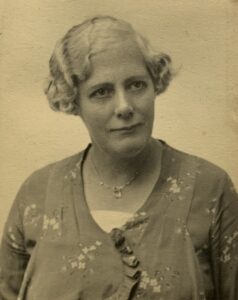
Lilian Fisher
The first photo is of my Great Grandmother, Lilian Fisher. Known as Lily or Lil. Lily was the eldest of 7 children born in rural Berkshire. Unknown to Lily, she was born around the time that inequities between men and women began to be addressed.
When Lily’s parents married in the middle of the 19th Century, women had very few rights; married women were actually regarded as the property of their husbands. Any money or property she may have brought to the marriage automatically became her husband’s.
By the time Lily was born at the end of 1882, a law had just been passed that allowed women to keep their own earned wages and inherited property. Imagine the implications of not having your own money if your marriage broke down.
Domestic Service
When she was 15, like most working-class women, Lily went into domestic service. She worked as a Cook; first with a small family in Reading in Berkshire and then for a much larger household in Kensington.
In the same year that International Women’s Day was started in 1911, Lily married Frank Warren and set up home in North London. By the start of the First World War, Lily and Frank had 2 daughters, Gladys (my Nan) and Florence, known as Flossie (my great aunt).
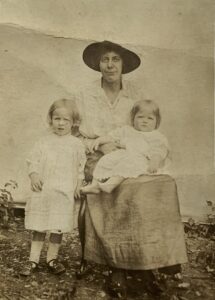
Lilian, Gladys and Florence
Voting Rights
Little by little the inequalities between men and women would be addressed during Lily’s life; such as the right to vote. These days it’s often taken for granted that everyone can vote in local and general elections, but this was not always the case.
Women had to wait until after the First World War in 1918, to be able to vote in general elections, but even then, there were restrictions. Despite the fact that many women had stepped up and into the shoes of men who left their jobs to fight for the country, women could still only vote if they were 30 years or older and who met a property qualification. Although 8.5 million women met the criteria, this was still only around a third of the total population of women in the UK.
With the passing of the Equal Franchise Act 1928, women finally achieved the same voting rights as men. This increased the number of women eligible to vote to 15 million.[1] Today, men and women aged 18 and over have the right to vote in general elections. Lily was 46 years old when she was finally permitted to vote in national elections without eligibility restrictions.
Women’s Work
After the First World War Lily, Frank and their girls settled into family life in a little terraced house in Egham. Gladys and Florence were able to join the Girl Guides, due to girls demanding something similar to the boy Scouts back in 1909.
When they left school, Aunt Floss worked as a packer in a laundry and my Nan worked in a women’s dress shop. Nan worked there until she married at the beginning of 1938. After her marriage, like the majority of newly married women, she left work and became a housewife. Nan never worked outside the house again.
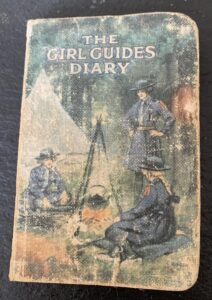
Girl guide diary 1927
By the time the Second World War broke out in 1939, Nan had been married for 18 months. She already had one son and there was another baby on the way.
During the Second World War, to keep the country running, women again took on the jobs that men had vacated. Women dug fields, worked in factories, and kept their family businesses going; often women juggled duty to their country with raising their children and keeping home with very few labour-saving devices.
The 1950s and 1960 saw the introduction of appliances that could help them to have a life outside the home. Devices like the refrigerator meant that women didn’t have to shop daily and the washing machine untied women from a kitchen sink full of handwashing. The introduction of these and other appliances freed up time for women to choose how they spent their time.
Equal Pay
Nan saw the battle for Equal Pay. During both World Wars women demonstrated their capability to carry out jobs that were ‘men’s work’. However, as time passed their pay packets did not reflect this. Most women were paid much less for doing the same job as men and it took a woman – in the form of Barbara Castle – to sort this out.
In 1968 Barbara Castle became Secretary of State for Employment and Productivity. She was made aware of a strike by women at the Ford car factory in Dagenham, who were not paid at the same level as men despite them doing an equally skilled job. Her involvement not only helped to get the women a pay rise, but she was also the driving force in the passing of the Equal Pay Act in 1970.

Gladys Warren
International Women’s Day
My Nan was very modern in her thinking and while equality had barely made changes to her own life, she was always pleased to see her grandchildren doing well. Most of her grandchildren are girls and she was always interested to hear what we were doing, at school or at work, where we were travelling to, and what we had planned next. She was proud of our achievements and always encouraged us to do more.
Lilly and Gladys were both nonagenarians when they died. Lilian died in 1975 aged 92 only a few years before Margaret Thatcher become the first female Prime Minister. My Nan was 91 when she passed away in 2003.
From 1882-2003 Lily, Gladys, and Florence saw and influenced many changes in women’s lives, allowing them more choice and freedom than their mothers and grandmothers had enjoyed. Did it happen overnight? No. It didn’t. It happened in a series of small steps, but happen it did.
In the words of the organisers of International Women’s Day, “Everyone everywhere can help forge women’s equality. Collective action and collaborative support for forging women’s equality matters, and all groups should be welcome to advance women’s equality by whatever appropriate means they choose.”
Lily, Gladys, Florence and their peers did this in their own way and while it may not have significantly changed their own lives, I would like to remember them and acknowledge ad applaud them for paving the way toward equality for future generations of women.
About me
Lorraine Whale is a qualified genealogist and family history researcher based on the South Coast of England. A member of @AGRAGenealogy and @RegQualGenes.
[1] https://www.parliament.uk/about/living-heritage/transformingsociety/electionsvoting/womenvote/overview/thevote/