And Then There Was One: Three Berkshire Brothers
When beginning World War I family history research, many people have stories of great-grandparents who served in The Great War. Often told by older family members, shown on service records, confirmed by medals and recorded on a few faded photographs. When delving deeper, what is discovered is something far more powerful: the human cost of war.
This is the story of three Berkshire brothers, Frank, Maurice and Harrison Fisher, who served in the British Army during the First World War, and how researching their military records revealed a story of loss, survival and remembrance.
A Berkshire Beginning
The Fisher family lived in the small village of Yattendon, nestled in the beautiful countryside of Berkshire. Yattendon was, and still is, a picture-postcard English village, closely tied to its neighbour Frilsham. Work dictated where the family settled; George Fisher, the boys’ father, moved between the two villages depending on the job he was doing at the time.
By 1914, George and Susannah Fisher had eight children. The eldest, Lilian, my great-grandmother, was born in 1882. She was followed by Francis (known as Frank), Florence (Flo), Maurice, Elsie, Dorothy, Harrison, and the youngest, Eileen, born in 1904. It was an ordinary rural family. Until history intervened.
Maurice Fisher – the First Battle of Ypres
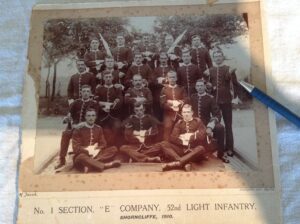 Maurice, born at the end of 1888 and baptised at St Peter and St Paul’s Church in Yattendon, had already chosen a military career before war began. He was serving with the Oxfordshire and Buckinghamshire Light Infantry, and in 1910 he was photographed with his section at Shorncliffe.
When war was declared in August 1914, Maurice would have been among the first British troops sent to France, part of the professional regular army that initially formed the backbone of Britain’s forces.
By October, he found himself in the First Battle of Ypres. The fighting was savage. Trenches filled with mud, rats, disease, and the relentless terror of enemy attacks. The battle shattered Britain’s original regular army.
Maurice was listed as “Missing” in a War Office casualty list in October 1914. Each day his family would have waited for news. Was he alive? Was he wounded or was he dead? The family did not have long to wait for the news; Maurice had died. His death was officially recorded as 1st November 1914 – he was 25 years old.
Today, he is one of thousands commemorated on the Menin Gate in Ypres, his name carved into stone among the missing.
Harrison: The Young Husband
Born in October 1895, Harrison Henry Fisher was the youngest son. He joined the Royal Sussex Regiment in 1914 from East Grinstead. He was just 19. Before the start of the War, he had been working on a farm in Sussex where he met Frances Kate Budgen, the daughter of a gamekeeper at Bramble Hill Farm at Turners Hill, Sussex.
In the spring of 1915, shortly before departing for France, Harrison married Frances. Perhaps a hurried, hopeful wedding with two young people clinging to normality in uncertain times.
Harrison and Frances’ daughter, Lilian Fisher, was born on 8th October 1915 and it is not known whether Harrison ever held her.
Harrison died in early June 1917 during the Battle of Passchendaele, another chapter of relentless mud, disease and unimaginable loss. Harrison was just 21 years old when he died. Like his brother Maurice, Harrison’s name is inscribed on the Menin Gate.
Frank: The Gardener Who Came Home
Francis George Fisher, known as Frank, was born on 23rd December 1884. Before the war, he had started a promising career as a gardener. He apprenticed at Highclere Castle, now famous as the filming location for Downton Abbey, and later worked at Grange Gardens in Alresford, Hampshire.
When war broke out, Frank joined the Royal Field Artillery and served in Europe. Remarkably, unlike his brothers, he survived.
Frank chose to honour his brothers in the only way he could. When he returned from the War, he returned to gardening and on 11th August 1920, he was appointed as a gardener with the Commonwealth War Graves Commission. He then returned to Europe, not as a soldier, but as a caretaker of memory.
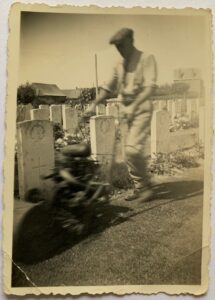 Every day, he tended the graves of the fallen. He worked among the rows of white headstones that marked the cost of war, perhaps pausing to remember his brothers and his comrades. In nurturing those grounds, he ensured that their sacrifice would not be forgotten.
Remembered
Maurice and Harrison are commemorated in St Frideswide Church in Frilsham, in the church at Yattendon, on the memorial at Turners Hill, and on the Menin Gate in Ypres.
Although the details are brief, behind the inscriptions on each memorial are two young men from a small Berkshire parish. Sons. Brothers. A husband. A father.
Family history often begins with curiosity. But sometimes it becomes something deeper, an act of remembrance.
And in the story of the Fisher brothers, it becomes a quiet testament to love, loss, and one man who came home and chose to honour those who did not.
Help with Your World War I Family History Research
Researching First World War soldiers can be challenging. Service records, casualty lists, regimental histories and Commonwealth War Graves Commission records all provide vital clues when tracing British Army ancestors.
If stories like this exist in your own family tree but you’re unsure where to begin, a qualified genealogist can help uncover them. Members of the Association of Genealogists and Researchers in Archives (AGRA) specialise in tracing military, naval and RAF ancestors, ensuring that their stories are remembered.
Frequently Asked Questions – FAQs
How can I find my ancestor’s World War I service record?
Many subscription family history websites can help with your search for WW1 records, including Ancestry, Findmypast and The Genealogist. You can also search the National Archives, regimental archives, and Commonwealth War Graves Commission records.
What if my WW1 ancestor is listed as missing?
Many soldiers commemorated on memorials such as the Menin Gate have no known grave but are recorded in official casualty lists.
Where can I research British Army soldiers from WW1?
Key sources include service records, medal rolls, pension records and regimental histories.
Where else can I look?
Here are just a few places to look for your family’s World War I history
- Army Medal Index Cards – https://www.nationalarchives.gov.uk/help-with-your-research/research-guides/british-army-medal-index-cards-1914-1920/
- War Diaries – some WW1 War Diaries have been digitised and can be seen online – others will need to be viewed at The National Archives.
- The Long Trail – https://www.longlongtrail.co.uk/
- Commonwealth War Graves Commission – https://www.cwgc.org/
- Imperial War Museum – https://www.iwm.org.uk/
- https://www.iwm.org.uk/research/tracing-your-family-history
- Casualty Lists – lists of the names of men killed, wounded or missing or held prisoners of war were compiled into lists that were produced by the War Office. The list would give the name, rank, number and regiment; later lists gave the place of residence. They can be found in newspaper archives (British Newspaper Archives / The Times) by subscription or sometimes free at your local library. Some can be found free on the National Library of Scotland Website. https://digital.nls.uk/british-military-lists/archive/144481815
- Prisoners of War – millions of people were captured and detained in detention camps during the First World War – indexes were created and are kept by the Archives of the International Prisoners-of-War Agency. These have been digitised and can be accessed on this site – https://grandeguerre.icrc.org/
- Facebook – don’t forget Facebook for groups. Miliary Museums often have Facebook pages, and the Shorncliffe Trust has an excellent group page https://www.facebook.com/groups/5003386747